
Before McLane Middle School, This Was Brandon's School |
The Knights Avenue campus traces its roots to Brandon's earliest classrooms, when one school served children from first grade through graduation. |
By Ralph
Drive along Knights Avenue today and the old McLane Middle School campus might look like another aging school property.
But more than a century ago, this was the center of education in a very different Brandon.
There were no sprawling subdivisions. No Brandon Town Center. No six-lane Brandon Boulevard filled with afternoon traffic.
And there certainly wasn't a school on every few miles of roadway.
Instead, children scattered throughout the rural Brandon community attended small schools—including one-room schoolhouses.
Eventually, residents decided Brandon needed something more permanent.
And the story of the property we know today as McLane Middle School began. Brandon's Early Classroom
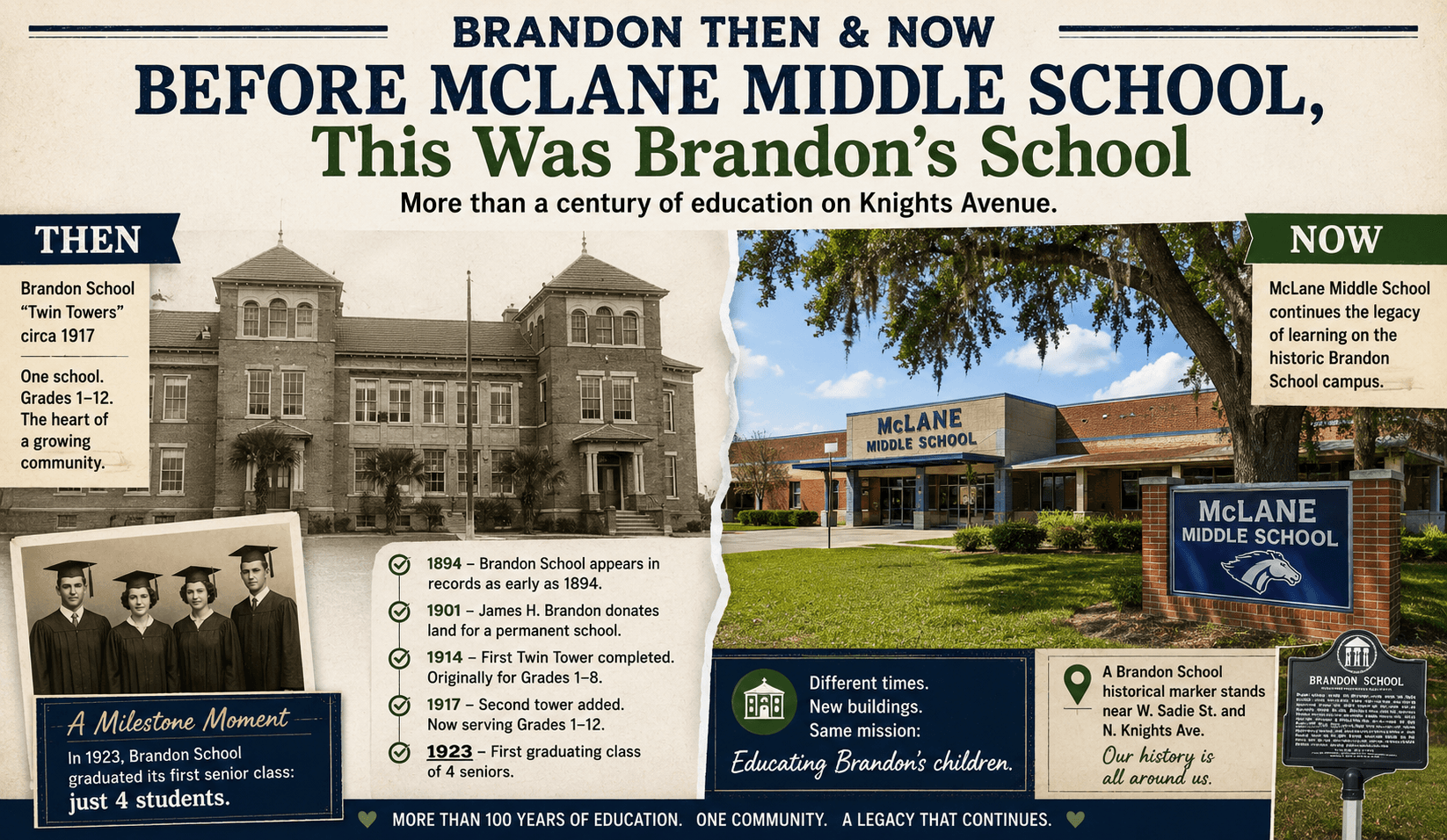
Brandon School appears in Hillsborough County school records as early as 1894.
Then, in 1901, residents established a special school tax district, and James H. Brandon donated land for a permanent school.
By the early 1900s, Brandon was still a small agricultural community.
As the population grew, residents wanted a larger school that could consolidate the smaller schools operating throughout the area.
Construction began on the Brandon School property.
In 1914, the first portion of what became known as the "Twin Towers" was completed. The two-story building initially accommodated students in grades one through eight.
But Brandon had another problem.
Older students didn't have convenient access to high schools in Tampa or Plant City.
So the community expanded its school.
A second tower was added in 1917, allowing Brandon School to educate children from first grade all the way through 12th grade.
Think about that for a moment.
Elementary school. Middle school. High school.
All on one Brandon campus. Four Students Made History
By 1919, enrollment at Brandon School had reached 119 students.
Principal John T. Bushong helped expand the school's curriculum through the high-school level.
Then came another milestone.
In 1923, Brandon School graduated its first senior class.
There were just four graduates.
Today's graduating classes can number in the hundreds.
Brandon's first consisted of enough students to fit comfortably inside a car. As Brandon Grew, the School Changed With ItFor more than three decades, Brandon School continued serving grades one through 12.
But after World War II, Brandon began changing quickly.
New roads improved access to Tampa. Subdivisions began replacing portions of the area's farmland and citrus groves. New families arrived, and additional schools became necessary.
Eventually, the old Brandon School campus became associated with McLane Middle School, while newer schools took over the educational roles once handled on that single property.
Yet the ground itself remained part of Brandon's educational story. Then & Now
THEN: A rural community consolidated its small schools into a central campus where children could eventually attend from first grade through high-school graduation.
NOW: Generations of Brandon residents recognize the Knights Avenue property as the longtime home of McLane Middle School.
The buildings changed.
Brandon changed.
Education changed.
But for well over a century, this piece of land has been connected to teaching Brandon's children. A Piece of the Story Is Still There
There's even a reminder for anyone willing to stop and look.
A Brandon School historical marker stands near West Sadie Street and North Knights Avenue, commemorating the school's place in the community's history.
It's easy to drive past without noticing it.
But that's one reason we do Brandon Then & Now.
Some of our community's most interesting history isn't hidden in a museum.
We're driving past it every day. The Crosstown Takeaway
Imagine Brandon in 1923.
A small rural community surrounded by farms and citrus.
One central school serving children across multiple grades.
And four seniors preparing to become its first graduating class.
More than a century later, hundreds of thousands of lessons have been taught on or around that same ground.
Buildings can become old.
Names can change.
Communities can grow beyond anything their founders could have imagined.
But sometimes a familiar piece of property quietly preserves the story of everything that came before.
|
0 Comments
Join the conversation
Be the first to comment
Share your thoughts above.