
From Family Mansion to Local Landmark: The Story of Brandon's Historic Homestead |
Built in 1876, a Brandon family home continues to serve the community 150 years later. |
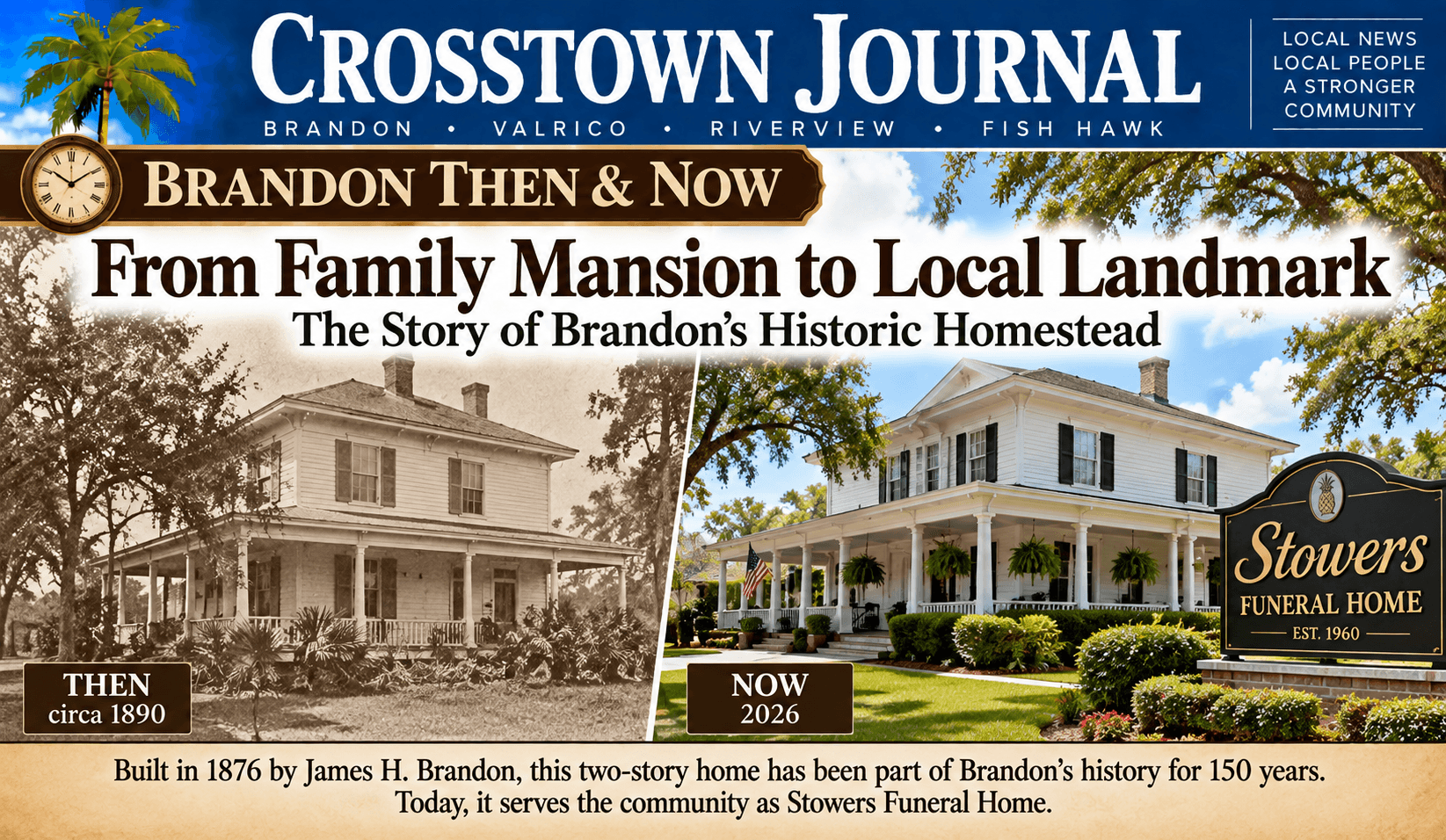
By Ralph | October 27, 2026
Thousands of motorists travel along Brandon Boulevard every day, passing businesses, restaurants, and shopping centers without giving much thought to what stood there generations ago.
But at 401 West Brandon Boulevard, one building offers a remarkable connection to the community's earliest years.
Today, it is known as Stowers Funeral Home. Long before it became a place where local families gathered to remember loved ones, however, it was a private residence belonging to a member of the family that gave Brandon its name.
The story begins in 1876, when James Brandon, son of community founder John Brandon, had a two-story frame home built on the property. A home from Brandon's earliest days
To appreciate the home's significance, it's worth remembering how different Brandon was during the 1870s.
John Brandon had arrived in the Tampa Bay area in 1857 and acquired land in what became the Brandon community the following year.
The settlement grew around families, farms, churches, and the beginnings of local commerce. This was decades before Brandon Boulevard became the busy commercial corridor residents recognize today.
When James Brandon's home was constructed in 1876, the railroad had not yet arrived in Brandon.
That would come in 1890, helping connect the developing settlement to surrounding communities and markets. The house therefore represents a period when Brandon was still a small rural settlement rather than the suburban community it would eventually become. From private residence to funeral home
As Brandon expanded through the twentieth century, many of its early homes and buildings disappeared or were replaced.
The James Brandon residence followed a different path.
The property eventually became home to Stowers Funeral Home, preserving a physical connection to the community's founding family while taking on a new purpose.
By 1961, Stowers Funeral Home was already an established local gathering place. In February of that year, a group of 17 men met there in the early organizational stages of what became Bell Shoals Baptist Church. That detail provides an interesting glimpse into how the building's role extended beyond its original residential purpose. A landmark surrounded by change
Consider the transformation of the neighborhood around the property.
The original rural roads became major thoroughfares.
Small farms and family homesteads gave way to subdivisions, shopping centers, and commercial development.
Brandon Boulevard, once known as Hopewell Road, became one of eastern Hillsborough County's busiest transportation corridors.
Yet the former Brandon family residence remained part of the landscape.
A historical account of the neighborhood identifies the Stowers building as the two-story frame home constructed for James Brandon in 1876, directly across Brandon Boulevard from North Knights Avenue. Its survival gives present-day residents a tangible connection to an era that otherwise exists largely in photographs, documents, and family histories. The family home that became a community institution
The building's history is more than a story of architecture. It is also a story of the families who lived there and the people who helped preserve it.
According to the historical marker on the property,
James Brandon and his wife, Johanna, raised seven children in the large Folk Victorian home. The family was known for entertaining guests there.
In 1901, William and Doc Estelle Brandon Varnedoe purchased the residence. Edward Linsley became its owner around 1912, and the Walter Clayton family occupied the home from 1946 to 1955. The building's most significant transformation came in 1960.
With financial support from John “Rudy” Williams, local businessman Richard “Dick” Stowers purchased the historic property and began converting it into a funeral home.
Stowers took care to preserve important features of the original house, including its woodwork, heart-of-pine flooring, and decorative molding. He also furnished the building with Victorian-era pieces and artifacts connected to Brandon's past. Stowers Funeral Home opened in 1961, beginning a new chapter in the building's history. Preserving a piece of Brandon's past
One of the most remarkable details about the Brandon Homestead is how much of its original structure has survived.
According to Stowers Funeral Home's official history, the home's exterior appearance and basic L-shaped floor plan have been preserved.
In 1990, a historical marker was dedicated at the property in honor of Brandon's centennial, with the marker donated by the Dick Stowers family. The building is also a reminder of Dick Stowers' broader contributions to the community. Beyond his funeral business, he supported numerous civic organizations, schools, and charitable efforts. A local elementary school was eventually named in his honor. Then and now: 150 years of Brandon history
Then — 1876 A two-story family residence built by James H. Brandon, son of the community's founder.
Now — 2026 Stowers Funeral Home, still occupying the historic property at 401 West Brandon Boulevard.
For 150 years, the Brandon Homestead has stood through the community's transformation from a rural settlement into one of Hillsborough County's largest suburban areas.
Its purpose has changed, but its connection to Brandon's history remains.
The next time you travel along West Brandon Boulevard, take a moment to remember that the historic white building near Knights Avenue was once home to a family whose name is still found throughout the community.
Sometimes, the most interesting pieces of local history are hiding in plain sight.
|
0 Comments
Join the conversation
Be the first to comment
Share your thoughts above.