When the Railroad Helped Turn a Tiny Settlement Into Brandon |
Brandon Then & Now |
By Ralph
Drive through Brandon today and it's difficult to imagine this community without busy roads, shopping centers, schools, restaurants and neighborhoods stretching in almost every direction.
But go back to 1890, and Brandon was a very different place.
There was no sprawling suburb east of Tampa. The community was known as New Hope, and cattle, citrus groves and farmland dominated the landscape. Then the railroad came through—and the future Brandon began taking shape.
Before There Was Brandon
The Brandon story begins with John Brandon, who came to this area in the 1850s.
John and his family settled in what was then known as New Hope. After the death of his first wife, he eventually returned to the area with his second wife, Victoria, and established another homestead. John died in 1886, but Victoria would play an important role in what happened next.
The Railroad Changes Everything
Railroads were transforming Hillsborough County during the late 1800s, connecting small agricultural communities with larger cities and markets.
In 1890, the Florida Central and Peninsular Railroad laid tracks through the area.
Victoria Brandon saw an opportunity.
Working with railroad civil engineer C.S. Noble, she had approximately 40 acres surveyed and platted for a townsite.
The new community was given a new name: Brandon — in honor of her late husband, John.
But Victoria apparently wasn't content merely having railroad tracks pass through town.
Historical accounts say nearby Limona had a depot while the railroad initially declined to give Brandon one of its own. Victoria rallied local residents and helped raise the money needed to construct a frame depot for Brandon.
That depot remained until the 1940s.
Welcome to Downtown Brandon — 1890 Style
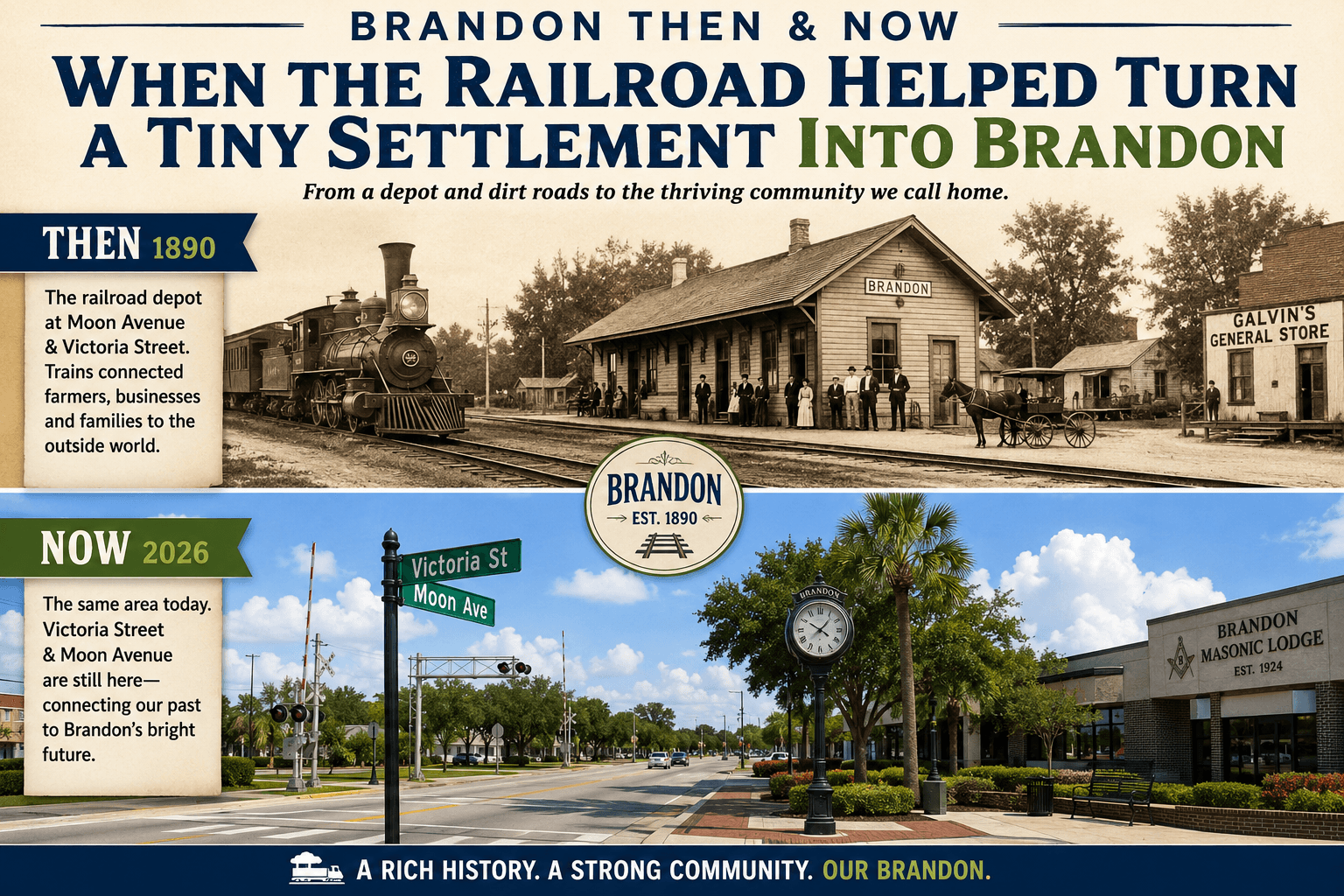
If you could stand near Victoria Street and Moon Avenue around the turn of the 20th century, you would have been near the center of town.
Within the immediate area were the railroad depot, Galvin's General Store, Varn's citrus packing house and the U.S. Post Office.
That post office was established on September 15, 1890, with Victoria Brandon serving as Brandon's first postmistress.
Instead of today's traffic and development, the surrounding countryside was populated by pioneer families raising cattle, growing citrus and farming their land.
For those early residents, the railroad was far more than transportation. It connected their little community with the outside world.
THEN: The Railroad Was Something People Wanted
Here's an interesting difference between Brandon then and Brandon now.
Today, living next to railroad tracks isn't usually considered a selling point.
In the late 1800s, railroad access could mean economic survival for a small community.
Trains carried passengers, mail and agricultural products to Tampa and beyond. Businesses and packing houses developed around rail access.
Communities fortunate enough to secure stops could gain an advantage over those that didn't.
That's why Victoria Brandon's determination to secure a depot mattered.
She wasn't simply asking for somewhere to catch a train.
She was helping position the young community for growth.
NOW: You Might Drive Past the Old Center of Town Without Knowing It
Modern Brandon no longer revolves around a railroad depot.
The depot itself disappeared decades ago.
And what residents consider the "center" of Brandon has changed dramatically as development spread outward.
But Moon Avenue and Victoria Street remain, carrying the names and geography of a much earlier Brandon.
There are other pieces of that history hiding in plain sight as well. The Brandon Masonic Lodge has occupied its Moon Avenue location since 1924, a reminder of the period when Moon Avenue was at the heart of community life.
A Piece of Brandon's Beginning Has Just Been Preserved
There's a timely reason to revisit this history.
On May 5, 2026, the Brandon Rotary Club and Hillsborough County Historical Advisory Council dedicated a new historical marker recognizing Brandon's establishment in 1890.
The marker, located at the Rivard-Simmons Rotary Event Center on South Kings Avenue, replaced one originally erected during Brandon's centennial celebration in 1990.
It's a small reminder of a very large transformation.
Brandon Then & Now
THEN: A tiny agricultural settlement surrounded by cattle, citrus and farmland, hoping the railroad would stop.
NOW: A large suburban community where tens of thousands of people live, work, shop, attend school and raise families.
Yet underneath today's Brandon, the original town is still there.
Moon Avenue. Victoria Street. The old homesteads. The names.
And the story of a widow named Victoria Brandon who recognized that a railroad could give a small community an opportunity to grow.
More than 135 years later, we're still calling that community Brandon.
|
0 Comments
Join the conversation
Be the first to comment
Share your thoughts above.