
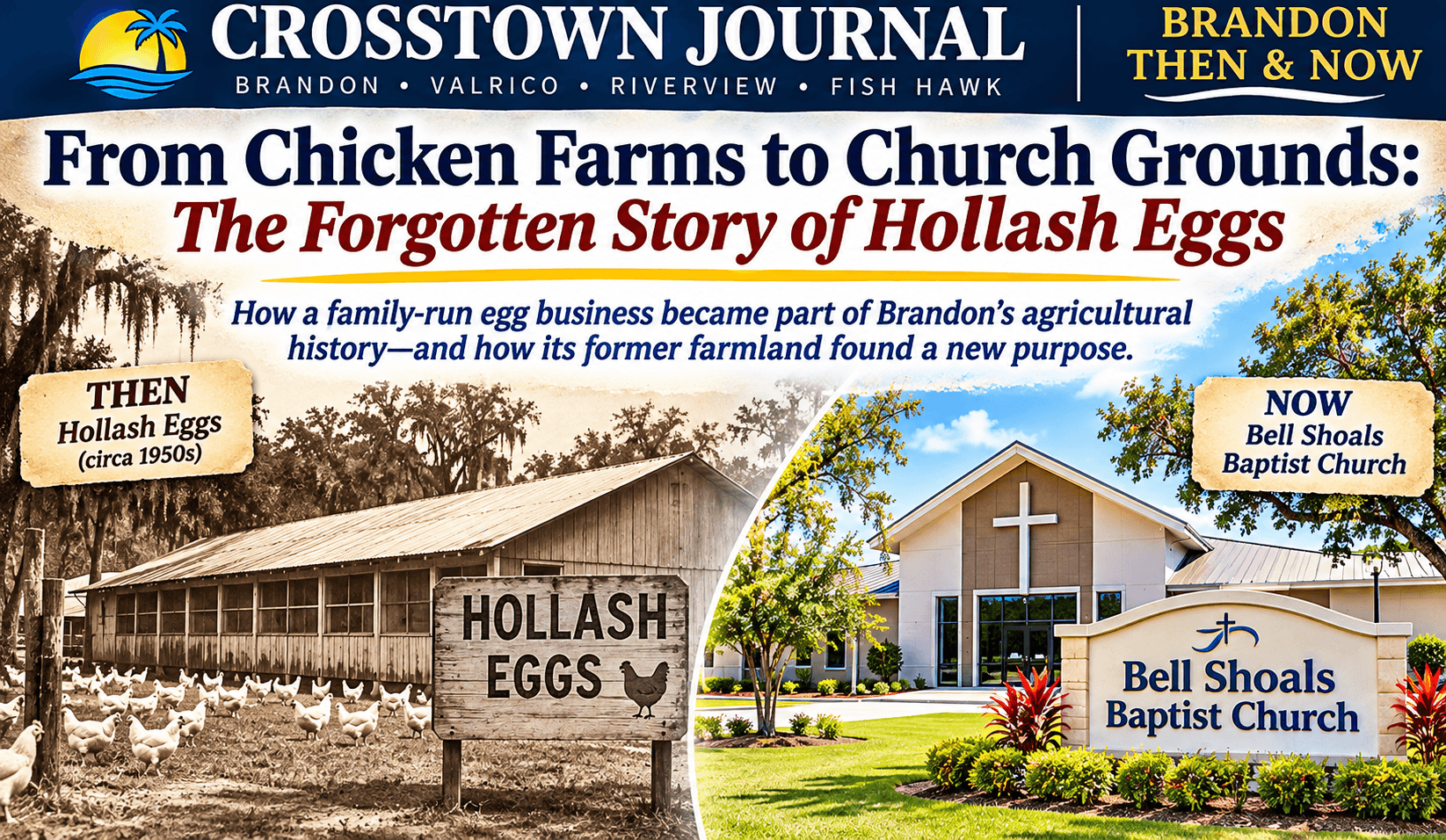
From Chicken Farms to Church Grounds: The Forgotten Story of Hollash Eggs |
How a family-run egg business became part of Brandon's agricultural history—and how its former farmland found a new purpose. |
By Ralph | Crosstown Journal
Long before Brandon became a bustling community of shopping centers, subdivisions, and busy highways, much of the area was covered with farmland.
Orange groves were a familiar sight, but citrus wasn't the only agricultural business helping support the growing community. Chicken farms also played a role in Brandon's early economy.
Among the families who helped build that industry were Bill and Ann Hollash, whose egg-producing business became a notable part of eastern Hillsborough County's history.
Their story offers a fascinating glimpse into Brandon's past—and an unexpected connection to a familiar local landmark. When Chickens Were Part of Brandon's EconomyDuring the 1920s, Brandon was still a small rural settlement.
East of what was then considered the community's boundary, near Pinewood Avenue, stood an area known as the Kingsway Poultry Colony.
Farmers raised chickens there during the winter months, supplying birds to markets in Ybor City.
The poultry colony was part of an agricultural economy that helped sustain the community before modern commercial development arrived.
Unfortunately, the Great Depression brought difficult times. The early poultry farms eventually closed, leaving behind another chapter in Brandon's agricultural history.
The Hollash Family Builds a Business
Around 1946, Bill and Ann Hollash moved to Brandon and established a business called Brandon Egg.
The timing was significant. World War II had ended, and communities throughout Florida were entering a period of economic growth and change.
The Hollash family's operation, later known as Hollash Eggs, grew into what historical accounts describe as the largest egg producer in eastern Hillsborough County.
For decades, the business represented an increasingly uncommon sight in Brandon: a working agricultural operation in an area gradually becoming more residential and commercial.
A Changing Community
As Brandon expanded during the second half of the twentieth century, farmland increasingly gave way to neighborhoods, schools, churches, and businesses.
The landscape that had supported poultry farms and other agricultural enterprises began to change. Hollash Eggs continued operating through much of that transformation before eventually closing in the late 1990s.
By then, Brandon had become a very different place from the rural community the Hollash family encountered when they arrived in the 1940s.
From Egg Farm to Church Property
Perhaps the most interesting part of the Hollash Eggs story is what reportedly happened to its original farmland.
Published local histories state that the farm covered more than 30 acres and that the property was eventually sold to what is now Bell Shoals Baptist Church.
The church, located along Bell Shoals Road, is a familiar institution to generations of Brandon-area residents.
The reported connection illustrates how land once devoted to agricultural production could take on an entirely different role as the surrounding community developed.
Although the historical accounts describe the sale, the original property transaction has not been independently verified through deed records.
Remembering the Brandon That Once Was
Today, it can be difficult to imagine chicken farms operating in areas surrounded by busy roads and established neighborhoods.
But businesses like Hollash Eggs remind us that Brandon's history was shaped not only by its founding families, schools, and railroads, but also by the people who worked the land.
Bill and Ann Hollash were part of a generation of local business owners who helped sustain the community through agriculture.
Their egg business eventually disappeared, but its place in Brandon's history remains worth remembering.
The next time you travel along Bell Shoals Road, consider how much the surrounding landscape has changed.
Where generations now gather for worship and community activities, historical accounts recall a time when farmland and poultry production were part of everyday life.
That's the beauty of Brandon Then & Now: discovering the stories hidden beneath the familiar places we pass every day.
|
0 Comments
Join the conversation
Be the first to comment
Share your thoughts above.