
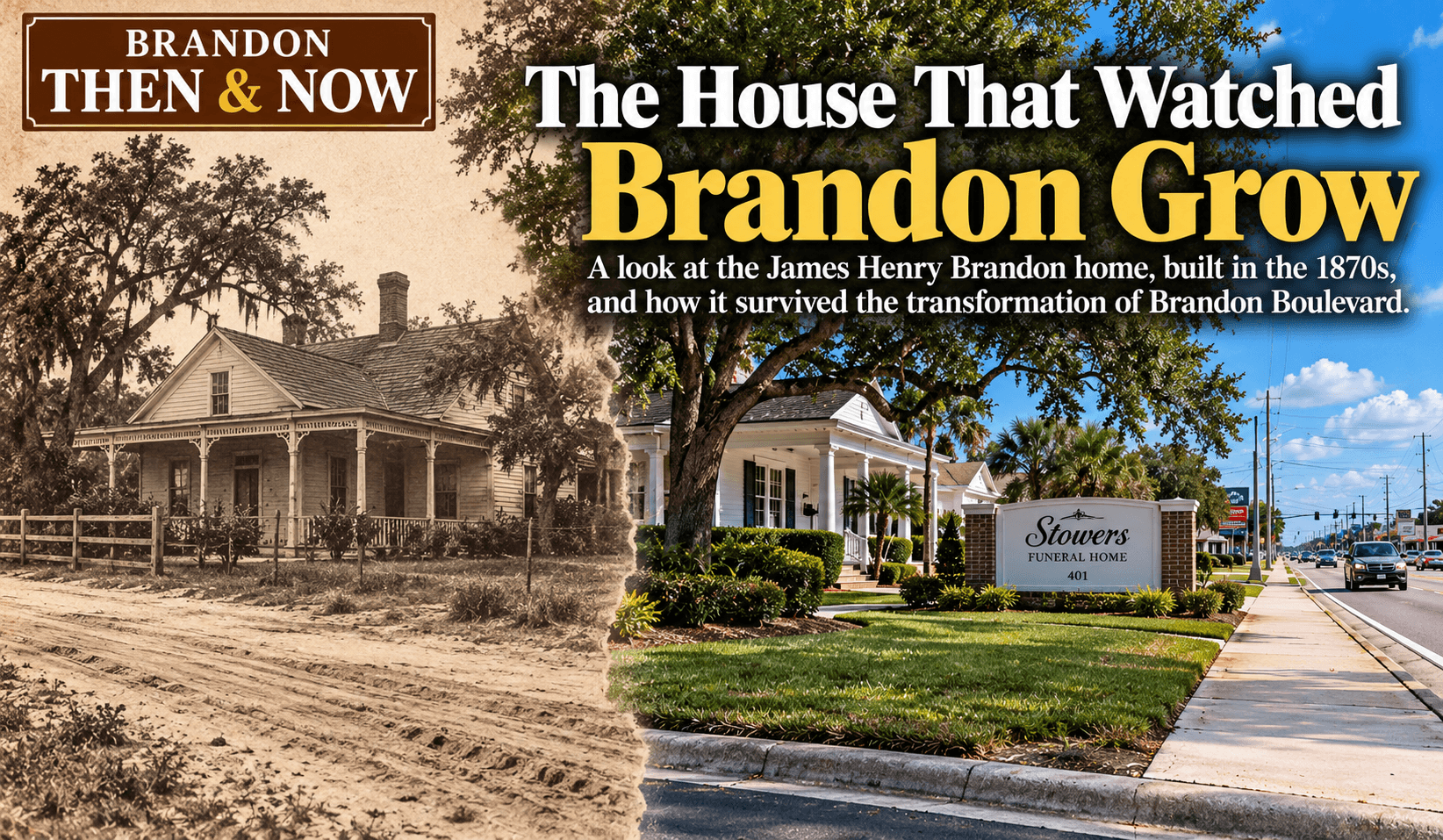
The House That Watched Brandon Grow |
Nearly 150 years ago, a member of the Brandon family built his home beside what would become Brandon Boulevard. The road changed. The community changed. Remarkably, the house survived. |
By Ralph
Drive west on Brandon Boulevard today and it's difficult to imagine the road without traffic.
Restaurants.
Shopping centers.
Car dealerships.
Office buildings.
Traffic lights.
Six lanes of automobiles moving through the heart of Brandon.
But at 401 W. Brandon Blvd., there's a connection to a very different Brandon.
Part of the historic home associated with James Henry Brandon, son of pioneer John Brandon, survives at the site now occupied by Stowers Funeral Home. Local historical accounts date the house to the 1870s.
Think about that for a moment.
That house was here before Brandon Boulevard.
Before the shopping centers.
Before most of the neighborhoods surrounding it.
Before automobiles filled the road outside.
And before Brandon became the suburban community we recognize today. Before Brandon Was Brandon
The story begins with John Brandon, whose family eventually gave the community its name.
John Brandon arrived in this part of Hillsborough County during the 19th century and established a settlement initially known as New Hope near what is now the Brandon area.
The landscape would have been almost unrecognizable to a modern resident.
There were no subdivisions stretching toward the horizon.
No Brandon Regional Hospital.
No mall.
No endless procession of businesses along State Road 60.
This was rural Florida.
Farms, homesteads, cattle and citrus would eventually dominate much of the surrounding countryside.
John Brandon's son, James Henry Brandon, became part of the next generation putting down roots here.
And sometime during the 1870s, James built the house whose story we're telling today. Then Came the Railroad
For a small rural community, 1890 changed everything.
That year, the railroad reached the area.
The arrival of rail service helped establish a recognizable center for the developing community around what are now Victoria Street and Moon Avenue.
The railroad connected local farmers and businesses with larger markets and helped encourage further settlement.
Around the developing village were the kinds of places every small community needed.
A railroad depot.
A general store.
A citrus packing house.
And eventually a post office. Brandon Gets a Post Office
On Sept. 15, 1890, Brandon received its first post office.
It operated from the home of Victoria Brandon, John Brandon's widow, who became the community's first postmaster.
That's an important moment because a post office did more than provide somewhere to collect letters.
It helped give a community an identity.
An address.
A name.
Brandon.
The family name was becoming the name of the place itself.
Meanwhile, James Brandon's house remained nearby as the little settlement grew around it. Hopewell Road Arrives
The road outside the old Brandon home didn't always look anything like today's State Road 60.
Older residents knew the route as Hopewell Road.
As we previously explored in Brandon Then & Now,
Hopewell was paved in 1925, initially as a road only about nine feet wide. Over time, that modest roadway evolved into today's multilane Brandon Boulevard/State Road 60.
Imagine watching that transformation from the front porch.
First horses and wagons.
Then the occasional automobile.
More cars.
More pavement.
More businesses.
More lanes.
Eventually, the quiet rural road became the commercial spine of an expanding suburban community.
And the old house stayed put. Brandon Begins to Explode
For decades, Brandon remained largely agricultural.
Citrus groves, farms and open land dominated much of the landscape.
Then Tampa began pushing east.
After World War II, improved roads and widespread automobile ownership made it increasingly practical for people to live outside Tampa and commute into the city.
Brandon began changing rapidly.
Groves became subdivisions.
Pastures became shopping centers.
Two-lane roads became four lanes—and eventually six.
The community that once consisted of scattered families and farms developed into one of Hillsborough County's major population centers.
And right through the middle of that growth ran Brandon Boulevard. The House Finds Another Purpose
Old buildings survive for many reasons.
Sometimes they're turned into museums.
Sometimes preservation groups rescue them.
And sometimes they survive because someone finds a practical reason to keep using them.
The James Henry Brandon house became associated with Stowers Funeral Home, which has operated at the Brandon Boulevard property for decades.
Historical accounts of Brandon note that the old home was incorporated into the funeral home's property rather than simply disappearing beneath later development.
That decision preserved something increasingly rare along Brandon Boulevard:
a physical connection to the community's earliest years. THEN & NOW
THEN: A member of the Brandon family lived along a quiet rural road in a community surrounded by farms, groves and open land.
NOW: The same location sits beside heavily traveled Brandon Boulevard, surrounded by the businesses, neighborhoods and traffic of modern Brandon. But unlike so many landmarks from the community's early days— the house remains. Imagine What It Has Seen
Buildings don't remember.
But if they did, this one would have stories.
It would remember when darkness actually fell over Brandon because there weren't thousands of streetlights and business signs illuminating the night.
It would remember the railroad arriving.
The post office opening.
Hopewell Road being paved.
The first automobiles becoming common.
The citrus industry expanding.
Families arriving.
Schools opening.
Subdivisions replacing farmland.
Shopping centers appearing.
Brandon Boulevard widening again and again.
And generations of Brandon residents passing outside.
Nearly everything around the house changed.
The house simply stayed. Hiding in Plain Sight
That's one of the things we enjoy most about Brandon
Then & Now.
History isn't always behind glass in a museum.
Sometimes it's sitting beside a road you've driven hundreds of times.
You may have passed 401 W. Brandon Blvd. on the way to dinner.
Or while heading to work.
Or while complaining about traffic.
And unless someone told you what you were looking at, there would be little reason to realize that a piece of Brandon's earliest history was right there.
So the next time you're traveling along Brandon Boulevard, take a look.
Don't stop in traffic.
Just look.
Try to erase the six lanes.
Remove the restaurants.
Take away the signs, parking lots and traffic lights.
Replace them with open countryside and a narrow road.
Then picture the Brandon family living there while the community carrying their name was still taking shape around them.
The road changed.
The landscape changed.
Brandon changed.
But after nearly a century and a half, the old house is still watching.
That's Brandon Then & Now. |
0 Comments
Join the conversation
Be the first to comment
Share your thoughts above.