
When a Little Girl Could Stop Traffic on Bloomingdale Avenue |
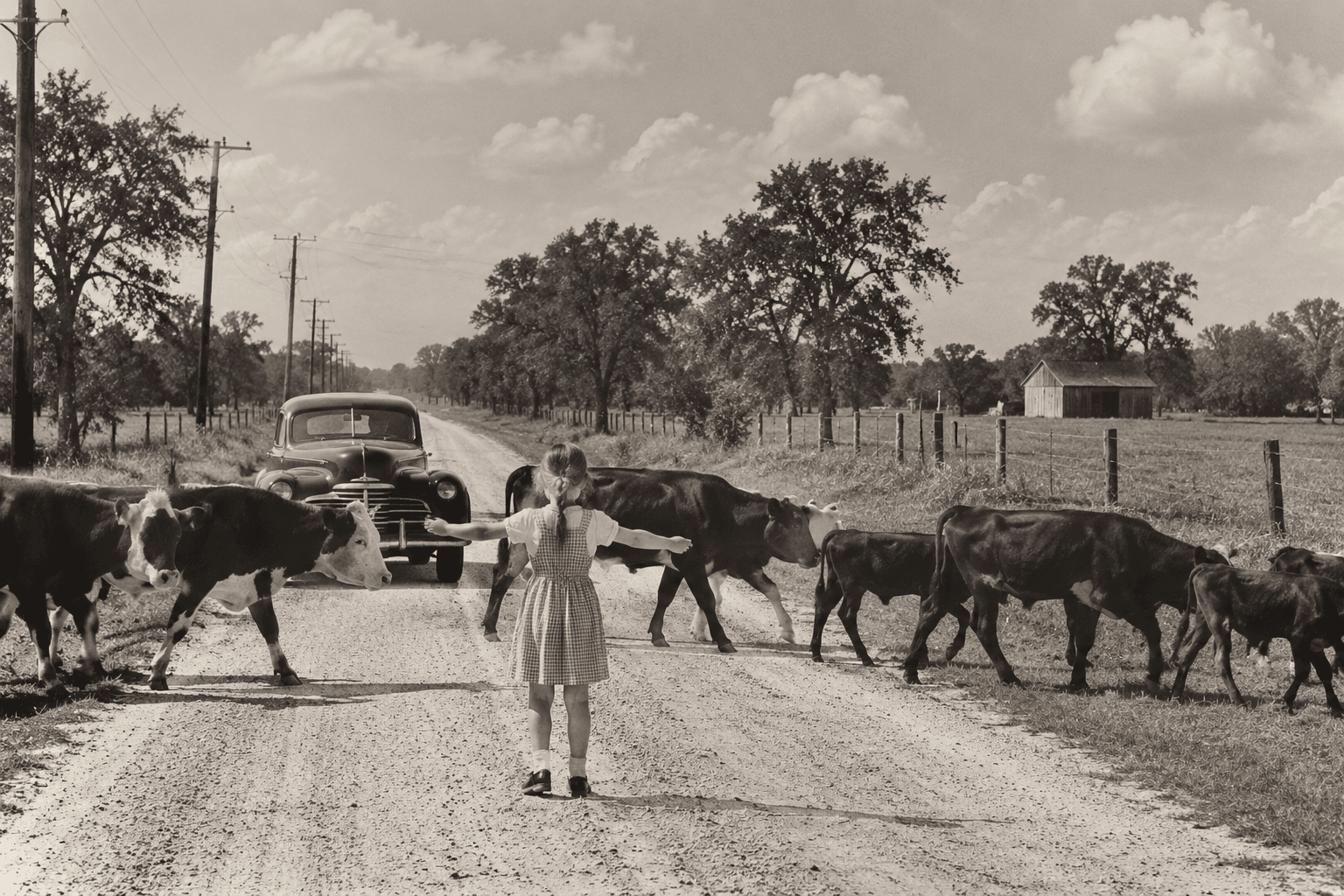
Before the shopping centers, restaurants and seemingly endless traffic, Bloomingdale Avenue was a gravel road running through cattle country—and one Brandon girl's job was to stand in the middle of it. |
By Ralph
Try something the next time you're sitting in traffic on Bloomingdale Avenue.
Look at the cars ahead of you.
Look in the rearview mirror at the cars behind you.
Then imagine the road without them.
No six lanes of traffic.
No Walmart.
No Chick-fil-A.
No sprawling shopping centers.
In fact, imagine being a little girl standing in the middle of Bloomingdale Avenue hoping a car would finally come along.
That's not an exaggeration.
It's a memory from a Brandon that has almost completely disappeared. When Bloomingdale Was a Gravel Road
Brandon native Candi Carter Martin grew up on family property along Bloomingdale Avenue.
Her great-grandparents, Thomas and Margaret Carter, had settled in the Bloomingdale area, and four generations of the family would eventually live on the property.
Back then, Bloomingdale Avenue bore little resemblance to the major commercial corridor residents know today.
It was a loose gravel road.
The Carter family raised cattle, and when those cattle needed to cross Bloomingdale Avenue, young Candi had a job.
She stopped traffic.
There was just one problem.
There usually wasn't any traffic to stop.
Martin recalled actually hoping a car would come along so she could perform her assigned duty.
For anyone who regularly drives Bloomingdale Avenue today, that may be the hardest part of this story to believe. Before the Stores Came the Cattle
The land where Martin grew up eventually became some of the most recognizable commercial property in the Brandon area.
According to her account, portions of the family's former property are now occupied by businesses including Walmart and Chick-fil-A.
Think about that transformation.
Where families once lived surrounded by open land and livestock, thousands of people now drive every day to shop, eat and conduct business.
Where a child could safely wait in a gravel road for the occasional automobile, modern drivers now navigate one of eastern Hillsborough County's busiest areas.
The road didn't simply get wider.
The entire way of life surrounding it changed. A Barn Became a Fire Station
The Carter property also played a small but important role in another part of Bloomingdale's history.
During the late 1960s and early 1970s, an unused barn on the property became the first home of the Bloomingdale Volunteer Fire Department.
It's a detail that says a lot about how communities operated before today's network of modern fire stations and professional emergency services had fully developed.
A growing community needed fire protection.
There was a barn available.
So the barn became a fire station.
The department eventually moved on as the community grew, but for a period of time, emergency protection in Bloomingdale operated from a structure that had once served an entirely different purpose. Then the Growth Arrived
Brandon and Bloomingdale didn't remain rural for long.
As Tampa expanded eastward and Hillsborough County's population grew, former agricultural land increasingly gave way to subdivisions, roads and commercial development.
Bloomingdale Avenue became an important east-west route.
The gravel disappeared.
The road widened.
Traffic increased.
Shopping centers arrived.
Restaurants followed.
The cattle pastures and family properties that once defined much of the area became increasingly difficult to find.
Eventually, the Carter family's land was sold and developed.
What remained were the memories. THEN & NOW
THEN: Bloomingdale Avenue was a rural gravel road passing family farms and cattle land. Traffic could be so sparse that a young girl assigned to stop cars while cattle crossed might wait without seeing one.
NOW: Bloomingdale Avenue is a heavily traveled commercial corridor surrounded by neighborhoods, restaurants, retailers and shopping centers—including development on land where the Carter family once lived.
Few comparisons illustrate Brandon's transformation quite as clearly.
Old photographs can show us buildings that disappeared.
Maps can show us roads that changed.
Population figures can tell us how quickly the area grew.
But sometimes one person's childhood memory tells the story better than any statistic. Try Imagining It
The next time you're stopped at a traffic light on Bloomingdale Avenue, particularly around the commercial areas near Walmart and Chick-fil-A, look around.
Strip away the pavement in your imagination.
Remove the parking lots.
Take down the signs.
Erase the restaurants and stores.
Replace them with open land, cattle and a gravel road.
Then picture a little girl standing alongside it with an important assignment from her family:
Stop the cars so the cattle can cross.
And picture her waiting.
And waiting.
And hoping that just one automobile might finally appear.
Today, anyone stuck in Bloomingdale traffic might appreciate the irony.
The little girl who once waited for a car would certainly have no trouble finding one now.
That's Brandon Then & Now. |
0 Comments
Join the conversation
Be the first to comment
Share your thoughts above.